The Knowledge Question: Capturing What Your Best People Know
Why training and knowledge transfer may be AI's most overlooked role in glazing.
Why training and knowledge transfer may be AI's most overlooked role in glazing
Last month, we looked at how AI agents can quietly carry on working when the office is closed. This meant handling enquiries, preparing briefings, drafting follow-ups overnight. The conversation was about what AI can do when no one is watching.
This month, a related question, but a more uncomfortable one. What happens when one of your most experienced people decides to leave?
Glazing has always run on knowledge that lives in heads, not systems. Your best surveyor knows which lintels in which property types are likely to be a problem. Your most experienced order processor can tell at a glance when a quote and a survey don't add up. Your senior installer remembers a specific sub-cill detail that comes up twice a year and catches everyone else out. None of that is written down. None of it is searchable. And none of it transfers cleanly when the person carrying it walks out the door.
The industry is acutely aware of this problem. We talk about it constantly. Recruitment is harder than it used to be. The people who built this sector are reaching the age where retirement isn't hypothetical, and the new entrants don't always arrive with the same depth of background. Most glazing business owners I speak to share a similar private worry. What happens if a key person goes?
For the first time, AI gives us a credible way to address that gap. Not by replacing experience, but by capturing it.
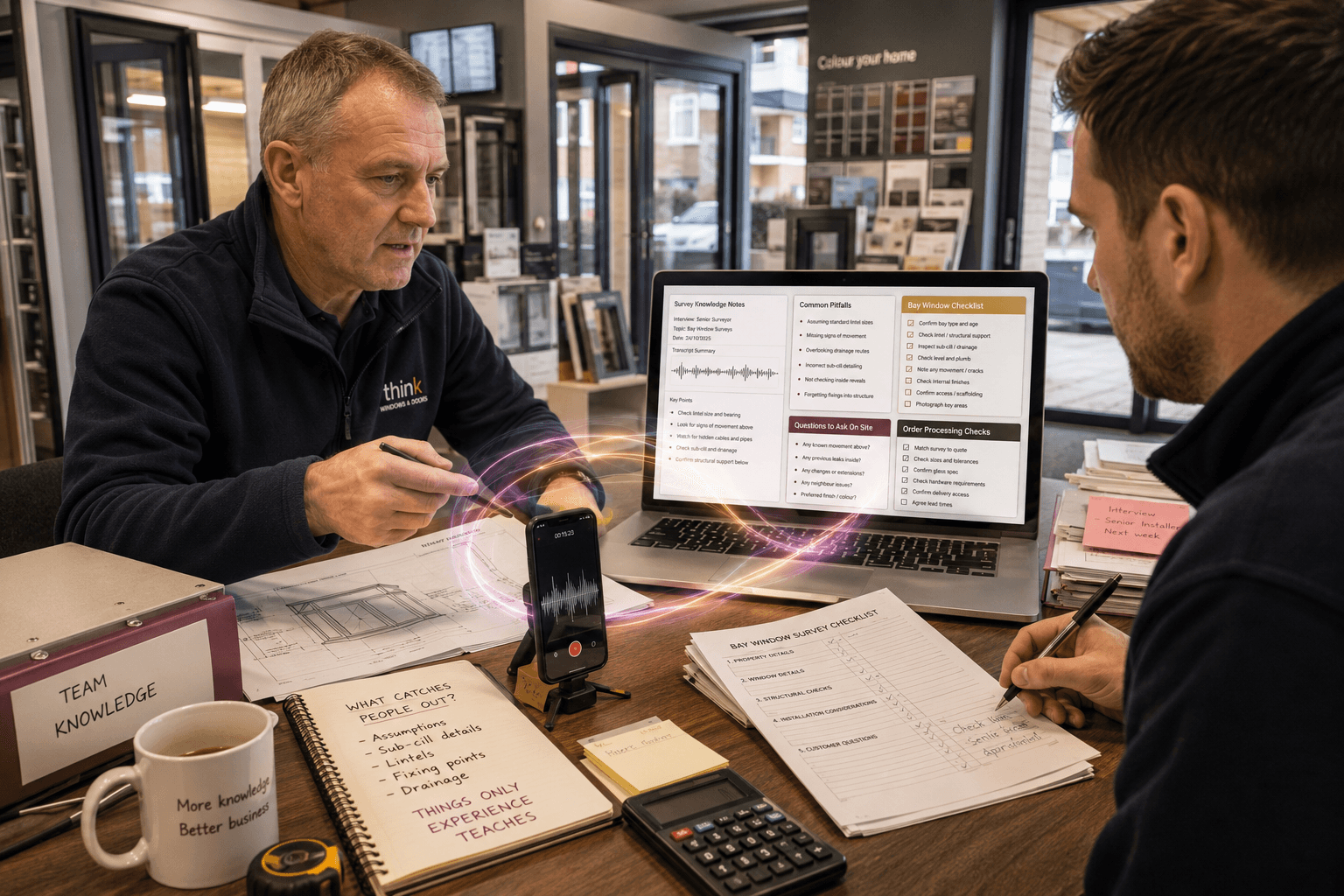
Start with the simplest version. Most experienced staff can talk fluently about their work for thirty minutes if you ask the right questions. They can't always sit down and document a process, because documenting feels like a chore. But they can describe what they do, why they do it, and what they've learned the hard way. AI can take that conversation and turn it into a structured reference document.
The workflow is straightforward. Sit down with a senior surveyor for half an hour. Record the conversation on a phone. Ask them to walk through how they approach a tricky bay window survey, what they look for, where new surveyors get caught out. Run the recording through a transcription tool. Feed the transcript into ChatGPT, Claude or Copilot, and ask it to extract a checklist, a set of common pitfalls, and a list of questions a new surveyor should be asking on site. What comes back isn't perfect. But it is structured, searchable, and shareable. And it took a fraction of the time a manual write-up would have taken.
That's the entry point. The strategic opportunity is bigger.
Imagine doing the same with your best order processor, your most experienced installer, your sharpest sales manager. Imagine, over the course of a year, building a quiet library of structured knowledge. Not glossy training manuals, but practical, sector-specific references that capture how your business actually works. Imagine the version of your company that exists when that library is in place. Onboarding becomes faster. Holiday cover becomes less stressful. The cost of someone leaving stops being existential.
There's a further step worth thinking about. Once that knowledge is structured, it can become a source for AI assistants inside the business. A new surveyor with a question on site doesn't need to ring the office and interrupt someone. They can ask an AI tool that's been fed the captured knowledge, and get a sensible answer drawn from your own people's experience. The tools to do this exist now (e.g. GlazingBot), and they're getting easier to set up every quarter.
It's worth being honest about the limits. AI can structure knowledge, but it can't decide what's worth capturing. That judgement still sits with the business. AI can summarise an interview, but it can't tell when an experienced person is leaving out the critical detail because they've forgotten it isn't obvious. The human conversation has to be good for the AI output to be useful. Garbage in, garbage out applies as strongly here as anywhere.
There's also a cultural piece. Some experienced staff worry that capturing their knowledge is a step toward replacing them. The opposite is usually true. The businesses that capture knowledge are the ones that value it most. They want to scale it, not lose it. Framing the conversation as, "we'd like to record what you've learned, because it matters," lands very differently to, "we'd like to document your job."
In a market that's tough and a workforce that's harder to recruit into, the businesses that get ahead won't necessarily be the ones with the slickest software. They'll be the ones who have figured out how to make their best people's knowledge available to everyone in the building, every day, without that person having to be in the room.
That's a strategic shift, not a technology shift. The technology has finally caught up to the problem. The question now is whether the industry will use it.
Most glazing businesses still treat training as something that happens when there's time, with the people who can be spared. The ones who'll be in a different position in three years are the ones treating knowledge capture as part of the job. AI doesn't replace experience. It just makes it easier to share, faster to transfer, and harder to lose.
Before the next senior person in your business takes their next holiday, ask yourself the uncomfortable question. If they didn't come back, what would the business actually miss? And then ask the better one. What would it take to make sure we never have to find out?
Originally published in Glass & Glazing Products.